Previous articles have introduced how to use parallel hybrid inverter in various operating modes, including the batteryless operation mode. However, many users still inquire about what the batteryless operation mode is. Below, Xindun will explain in detail what the batteryless operation mode is.
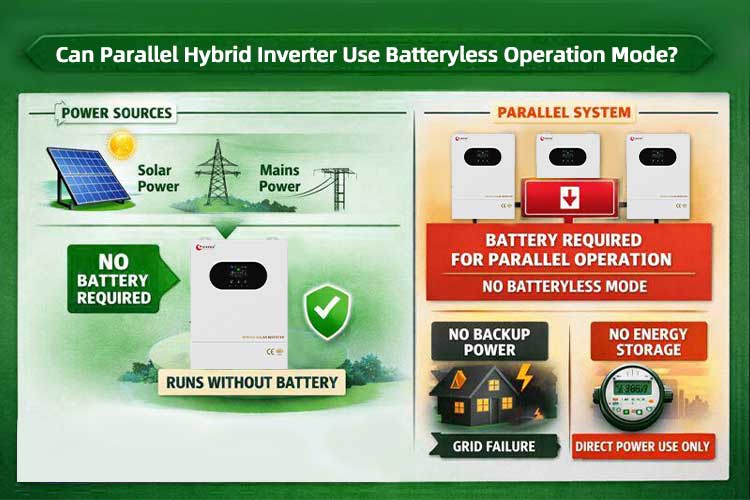
Batteryless operation mode refers to the state where the parallel hybrid inverter can still provide power solely through solar power or grid power without connecting any battery. This mode can be used when users only want the inverter to generate solar power for their own consumption or to stably supply grid power, without temporarily activating energy storage backup. Furthermore, the batteryless operation function of parallel hybrid inverters lowers the initial investment threshold for users and increases the flexibility of using the solar power system.
Parallel hybrid inverter in batteryless operation mode are commonly used in two scenarios:
1. Users want to install solar system first, and then add energy storage batteries later as needed.
2. Users only need solar power for their own consumption and do not require a backup power source.
When parallel hybrid inverter is not connected to battery, it needs to be connected to either mains power or solar power to start:
1. Mains power start up: Connect to normal mains power (AC voltage within allowable range), and the inverter will establish its internal power supply and start.
2. solar power start up: Connect to solar array. When there is sufficient sunlight (solar voltage within MPPT range), the inverter uses solar power to establish its internal power supply and start.
When parallel hybrid inverter is in batteryless operation mode, some functions are limited or unavailable:
1. Overload protection: Without battery, the inverter cannot provide instantaneous power support. If the load includes inductive equipment such as motors and pumps, the starting current may be 3-5 times the rated value. Ensure the inverter's rated power is sufficient to handle this; otherwise, overload protection may be triggered.
2. Backup Power Function: When the mains power fails or the solar system is insufficient/unavailable (cloudy days/nighttime), the system will completely stop outputting power and cannot provide any power to the load.
3. Energy Storage and Peak Shaving: It cannot store electrical energy, therefore it cannot implement the economical strategy of charging the battery during off peak hours and discharging it during peak hours.
4. Improved Power Quality: It cannot provide a more stable, pure sine wave power supply than the mains power through battery inverter output (in bypass mode, the load directly uses mains power).
5. Some Advanced Settings: Parameter settings related to battery charging and discharging in the menu (such as charging current, boost/float charge voltage, etc.) will be invalid or unapplicable.
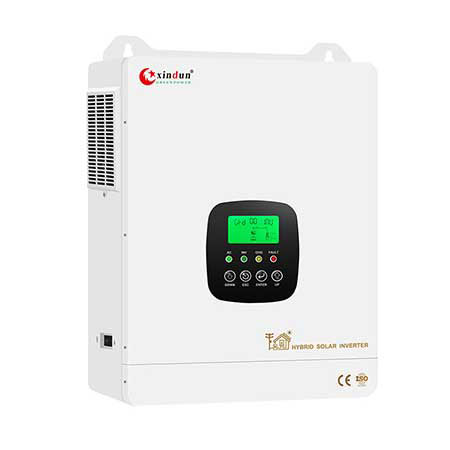
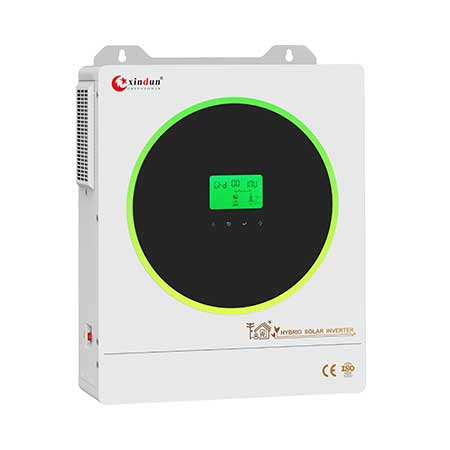
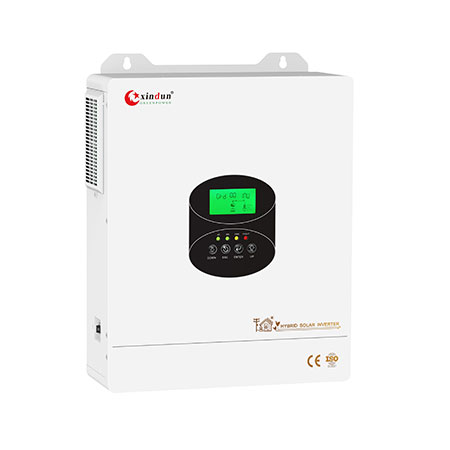
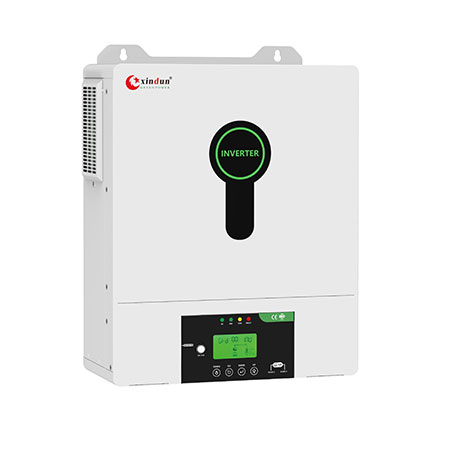
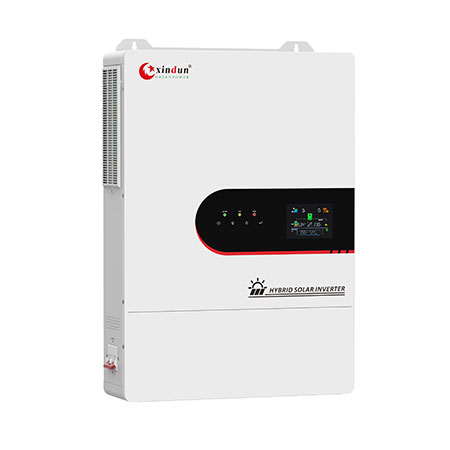
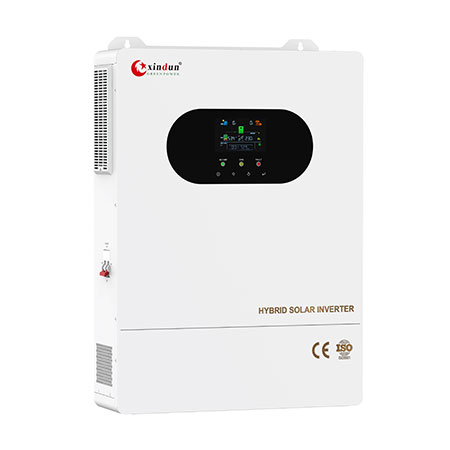
All Xindun high frequency hybrid inverters support batteryless operation mode. The Xindun HFP, HFP-C, HFP-E, HFP-S, HU, and HP Plus+ series inverters are all parallel hybrid inverters that can be set to hybrid/off grid/on grid modes, with solar/mains/battery cooperating and complementary functions, and all support batteryless operation mode.
|
|
HFP Series Batteryless Hybrid Inverter 1KW-12.3KW DC12V/24V/48V to AC 220/230/240V It supports bidirectional power flow, allowing both solar and mains power to charge the battery, making power usage more flexible. Built in MPPT solar controller with maximum solar input voltage of 500V, enabling efficient use of solar power generation.
|
|
|
HFP-C Series Batteryless Hybrid Inverter 4.3KW-12.3KW DC24V/48V to AC 220/230/240V It boasts a stylish design with RGB ring light strip that offers eight adjustable colors. It also features dual AC outputs. |
|
|
HFP-S series Batteryless Hybrid Inverter 3.3KW-12.3KW DC24V/48V to AC 220/230/240V The dual AC output design features equal frequency, voltage, and phase outputs, divided int main output and second output, enabling intelligent load management. |
|
|
HFP-E Series Batteryless Hybrid Inverter 3.3KW-12.3KW DC24V/48V to AC 220/230/240V Featuring detachable remote LCD control panel, it allows for user friendly assembly and flexible design. It also supports dual AC outputs. |
|
|
HU Series Parallel Hybrid Inverter 10KW/12KW(US) DC 48 to AC 100/105/110/120V, L1-N-L2(L1-L2:200/210/220/240Vac;L1-N/L2-N:100/105/110/120Vac) It supports setting split phase input and split phase output or American standard single phase input and single phase output functions, making it suitable for the Latin American market. It also supports parallel operation to meet flexible expansion needs. |
|
|
HP PLUS+ Series Parallel Hybrid Inverter 10KW/12KW(EU) DC 48V to AC 200V/208V/220V/230V/240V It supports parallel operation, with up to 6 units connected in parallel to meet power demands at different times. It also features time of use charging and discharging settings to take advantage of peak and off peak electricity pricing and save on electricity costs. |
The batteryless operation mode of hybrid inverters offers users greater flexibility, enabling them to start solar projects at lower cost. Users need to clearly understand that its core function is power generation and on demand use, not energy storage or backup power. When installing solar power system, users should decide whether to configure battery in the initial stage of system installation based on their actual needs for backup power and peak valley electricity pricing management.
The parallel operation function of paralle hybrid inverter allows for flexible expansion of system power to meet larger scale electricity demands, making it the preferred solution for industrial, commercial, and large scale residential solar projects. However, our inverter supports parallel operation function, and also supports batteryless operation in standalone mode, such as the Xindun HP Plus+ and HU hybrid inverters. When actually connecting inverter in parallel, many users are concerned about one question: Does parallel hybrid inverter parallel system support batteryless operation?
The answer is no. In inverter parallel system configuration, all parallel inverters must be connected to the same battery bank. Parallel system do not support batteryless operation . This is fundamental to ensuring normal startup, synchronized operation, and long term stability of the parallel system.
The battery bank provides stable and unified DC bus voltage reference for all parallel inverters. This is the physical basis for achieving precise power distribution, current sharing, and output phase synchronization among multiple devices. Multiple inverters need to perform power distribution and output synchronization based on this reference. Batteryless, directly using solar energy can lead to system instability due to the uneven distribution of solar power output. This can cause hybrid inverter parallel operation failure, abnormal output, or direct entry into fault protection mode.
Taking the Xindun hybrid inverter as example, attempting to build parallel system without battery not only fails to operate normally but also introduces several risks:
1. System Failure to Start: Lacking the initial stable voltage provided by battery, the inverter cannot establish normal operating bus, directly triggering alarms such as "Battery Not Connected" (fault code 03). The system will interpret this as hardware configuration error, thus prohibiting startup or stopping operation to avoid potential damage to the equipment itself or downstream loads.
2. Triggering Multiple Protections: Even with forced startup, the lack of battery voltage buffering can cause abnormal bus voltage, triggering overvoltage and undervoltage protections. Frequent shutdowns not only affect usability but may also damage core inverter components.
3. Safety Hazards: Batteryless parallel system have no buffering capacity to cope with sudden load changes and grid fluctuations, making them highly susceptible to current surges, potentially leading to wiring overheating, component burnout, and other safety accidents.
Battery is not merely "add ons" in inverter parallel system, but rather crucial components ensuring the stable operation of solar power system; their role is indispensable. Xindun hybrid inverters are designed to deeply integrate the management of three energy sources: solar, battery, and grid power. Energy storage battery play core role in the entire system, acting as energy buffers, peak shaving, and emergency backup power, a role particularly important in parallel system.
In inverter parallel system, the coordinated operation of multiple inverters relies on a stable bus voltage. Battery can quickly compensate for voltage fluctuations, preventing system protection or faults triggered by voltage imbalances and stabilizing the system voltage.
When the load suddenly changes (such as the startup of high power equipment), batteries can instantly release energy to supplement power supply, preventing system output interruptions or shutdowns due to power shortages, acting as load buffers.
When solar power supply is unstable or grid power fluctuates, battery can store excess energy and release it when needed, ensuring the continuity of power supply in the parallel system, especially playing a critical transition role when switching operating modes (hybrid/off grid/on grid).
To ensure the stable operation of the inverter parallel system, the battery pack must be configured strictly according to the product specifications to avoid unauthorized operation in batteryless mode. In addition to ensuring battery is connected, the following points should be noted:
1. The battery type must match the inverter settings (supports lead-acid battery, lithium battery, etc.; the corresponding battery type must be selected in the parameters).
2. Battery wiring for all parallel inverters must be completed simultaneously; partial battery connection and partial disconnection are not permitted.
3. Battery must have good consistency (consistent capacity, voltage, and internal resistance) to avoid affecting the overall system due to differences in the performance of individual battery.
4.Before connecting battery, disconnect the mains power, solar input, and load switches of all inverters to ensure a safe wiring process without the risk of electric shock.
Our HU and HP PLUS+ series hybrid inverters - the power of a single unit is 10KW/12KW, both support parallel operation, with maximum of six units operating in parallel for flexible expansion and a total power output of up to 60KW/72KW. They feature off grid, on grid, and hybrid operating modes, which users can customize. Built in MPPT solar controller allows for maximum PV input voltage of up to 500Vdc, effectively improving PV access capabilities and overall system efficiency. They also include time of use charging/discharging settings, allowing users to configure charging/discharging strategies based on actual electricity demand and usage habits, fully utilizing solar power to achieve peak shaving and valley filling, and reducing electricity costs.
So what are the differences between them?
1. The HU supports split phase input and output or US standard single phase input and split phase output, flexibly adapting to applications in US dual voltage standard regions, making it suitable for residential and commercial scenarios requiring split phase power supply. In addition, it supports four parallel output modes: single phase parallel output, 2 phase split phase parallel output, split phase parallel output, and three phase parallel output.
2. The HP Plus+ conforms to the European standard and supports either single phase or three phase parallel output, typically meeting the 220V, 50Hz voltage standard, making it suitable for markets such as Spain, Poland, Portugal, Italy, and the Netherlands.
For more information on parallel operation of hybrid inverter, please contact the Xindun Power team.