Many regions worldwide still face problems such as unstable power supply, frequent power outages, and soaring electricity costs. The reasons for these power supply difficulties include energy production disruptions caused by frequent extreme weather events, insufficient supply due to depleted traditional energy reserves, surge in electricity demand driven by global economic recovery, and aging power grid infrastructure struggling to handle peak loads. This surge in electricity demand has driven the development of sun panel system, and the use of sun panel inverter, as the core component of these systems, has increased significantly, gradually becoming an indispensable energy conversion device in daily life and work.
However, many customers who purchase sun panel system have misconception about sun panel inverter: they believe that having sun panel is enough to make inverter work. Is this really the case? Xindun Power will explore this question in depth below.
Sun panel inverter is the "bridge" connecting sun panel and electrical appliances. Its core function is to convert electrical energy into its electrical form. This function relies on the coordinated operation of two core components: sun panel and inverter.
Sun panels are the "energy harvesters" of sun panel system, operating on the sun effect.
Their main function is to directly convert sunlight into direct current (DC). They are composed of sun battery. When sunlight shines on the surface of the battery, the sun effect occurs, generating an electric current. The power generation capacity of sun panel is affected by factors such as sunlight intensity, installation angle, temperature, and obstructions, and the DC output is not always stable. Sun panels made of different materials vary in conversion efficiency, cost, and stability. Monocrystalline silicon panels have higher conversion efficiency, reaching 20%-25%, and offer stable performance, but are more expensive. Polycrystalline silicon panels have conversion efficiency between 15%-20%, lower cost, and are more widely used.
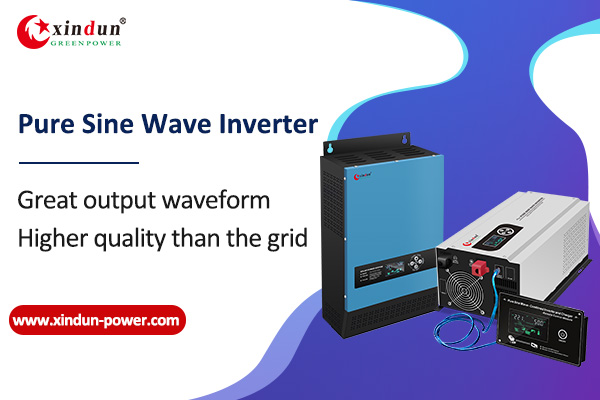
Inverter is the "energy converter" of sun panel system. Its function is to convert the direct current (DC) generated by sun panels into alternating current (AC) used by everyday appliances. Most household appliances, such as refrigerators, air conditioners, and televisions, require AC to operate, making the inverter an indispensable "power conversion hub" in sun panel system. Xindun Power's sun panel inverter not only convert electrical energy but also feature voltage regulation, power management, protection functions, and system monitoring.
Sun panels and inverters are the core components of sun panel inverter. So, can inverter only generate electricity from sun panels?
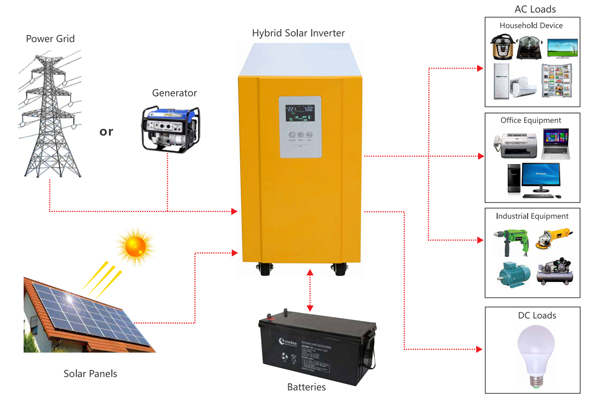
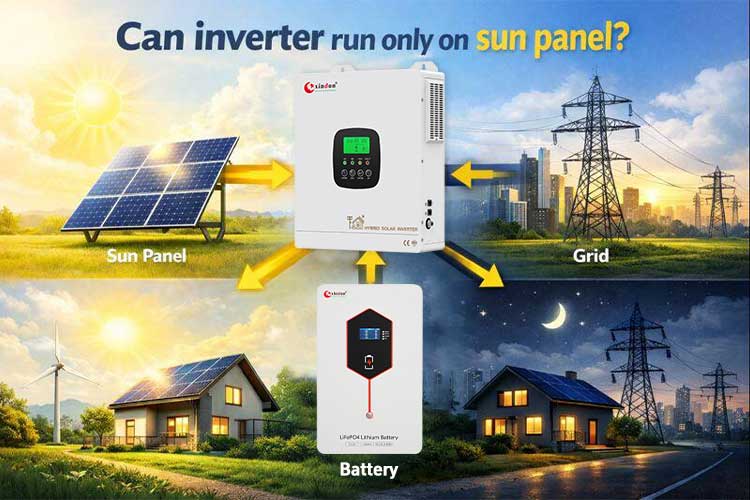
The answer is no. While sun panels are the primary initial power source for sun panel system, the inverter doesn't rely solely on them for power. Besides sun panels, batteries play a crucial role in the system. During the day, when sunlight is abundant, some of the electricity generated by the sun panels is directly supplied to the loads via the inverter, while excess energy is stored in the battery. At night, when there is insufficient sunlight causing the sun panels to stop generating electricity, or in the event of grid failure, the batteries act as backup power, supplying DC power to the inverter, which converts it to AC power to ensure the loads continue to operate normally.
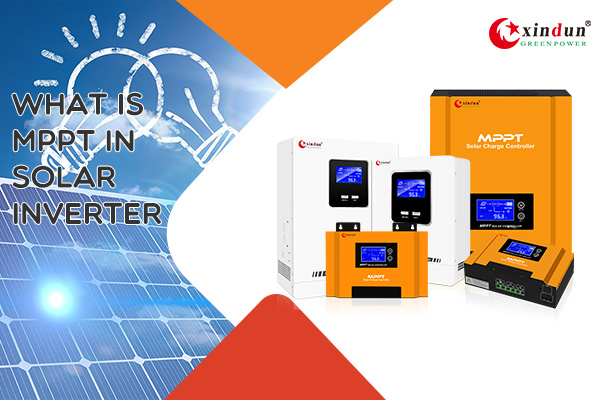
A complete sun panel system typically consists of sun panels, inverter, battery, and sun controller. Throughout the process of the sun panels charging the battery and the battery supplying power to the inverter, the sun controller is indispensable core component, essentially the "housekeeper" of the sun panel system. Its main function is to precisely manage the charging and discharging process of the batteries: during charging, it prevents overcharging, avoiding damage due to overheating and electrolyte loss, thus extending the battery's lifespan; during discharging, it prevents over discharging, preventing capacity reduction and performance degradation.
These components, as the core parts of sun energy system, work together to ensure stable system operation and efficient utilization of sun power.
The parameter matching between sun panels and inverters directly affects system efficiency. Parameters such as the inverter's MPPT voltage range and DC input voltage limit must be strictly matched with the output voltage after the sun panels are strung together. For example, the common MPPT voltage range for string inverter is 450-1000V. The voltage after the sun panel is strung together must fall within this range for the inverter to effectively activate the MPPT function and track the maximum power point. If the voltage is below the lower limit of the MPPT, the inverter may not function properly, if the voltage exceeds the upper limit of the DC input, overvoltage protection will be triggered, causing the inverter to shut down or even be damaged. Simultaneously, the rated power of the inverter must also match the maximum output power of the sun panel to avoid overload and over limit situations leading to energy waste, or insufficient input power preventing the inverter from starting.
The coordinated protection of sun panel and inverter ensures system safety. When sun panel experience malfunctions such as shading or cracking, abnormal output voltage or current may occur. Upon detecting this anomaly through built in sensors, the inverter will reduce the power output of the corresponding string or trigger string sleep mode to prevent the fault from spreading. Conversely, if the inverter experiences over temperature or over current faults, it will immediately disconnect the DC input circuit to the sun panel to prevent the fault from affecting them. This coordinated protection mechanism is a crucial guarantee for the safe operation of the entire sun panel system.
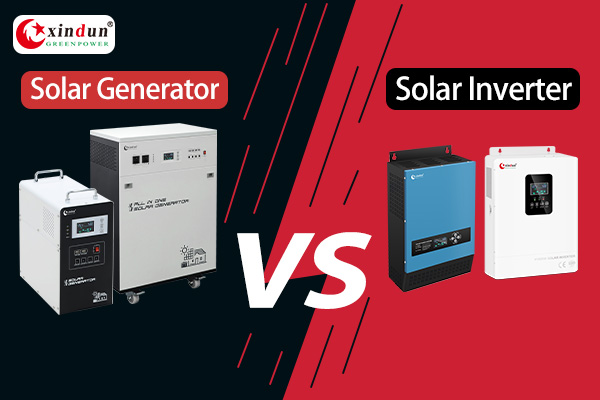
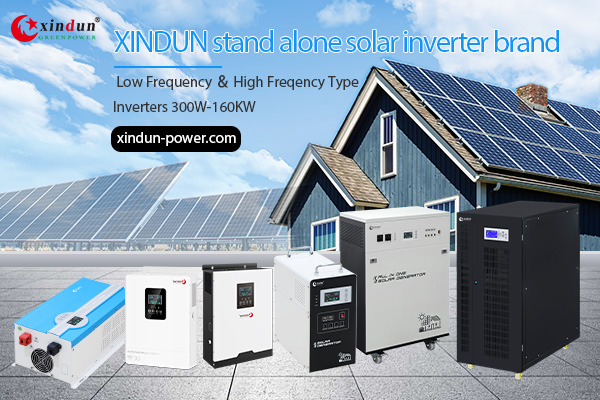
The above analysis of sun panel and inverter aims to help customers correctly understand sun panel inverter. As a source manufacturer of sun panel inverter, Xindun Power offers a diverse range of inverter, including off grid inverter, hybrid inverter, single phase / split phase / three phase inverter, high frequency/low frequency inverter, and sun generator. We also provide sun panel system components such as sun panel, sun controller, and sun battery. If you are unsure how to match a complete sun panel system for your sun project, Xindun Power offers one stop customization service.